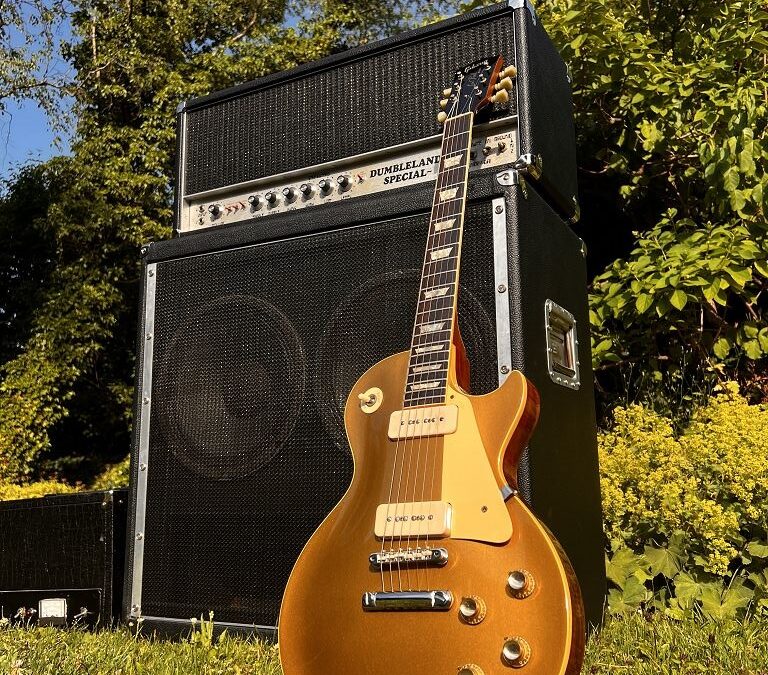
Well, the time has finally come—for the first time ever, we have a Dumble amp at the Captain Guitar Lounge! There are, after all, countless legends, myths, and fairy tales surrounding Howard Alexander Dumble’s creations.
And no term is misused more often in the world of guitarists than the word“Dumble.” There are plenty of Dumble replicas on the market—amps and pedals designed to recreate that legendary sound. But how can that be, if every Dumble amp has been customized for its buyer and therefore sounds different?

Anyway, here it is—the Holy Grail of amplifier technology. Dumble built about 300 amplifiers until his death on January 16, 2022. Most of them were Overdrive Specials. Only twelve copies of the Dumbleland Special were produced; this one is numbered 0011.
I was skeptical at first. Okay, those transformers are huge—I’ve never seen anything like them before. The device weighs just over 30 kg. Without a flight case. You can’t carry the cabinet by yourself.
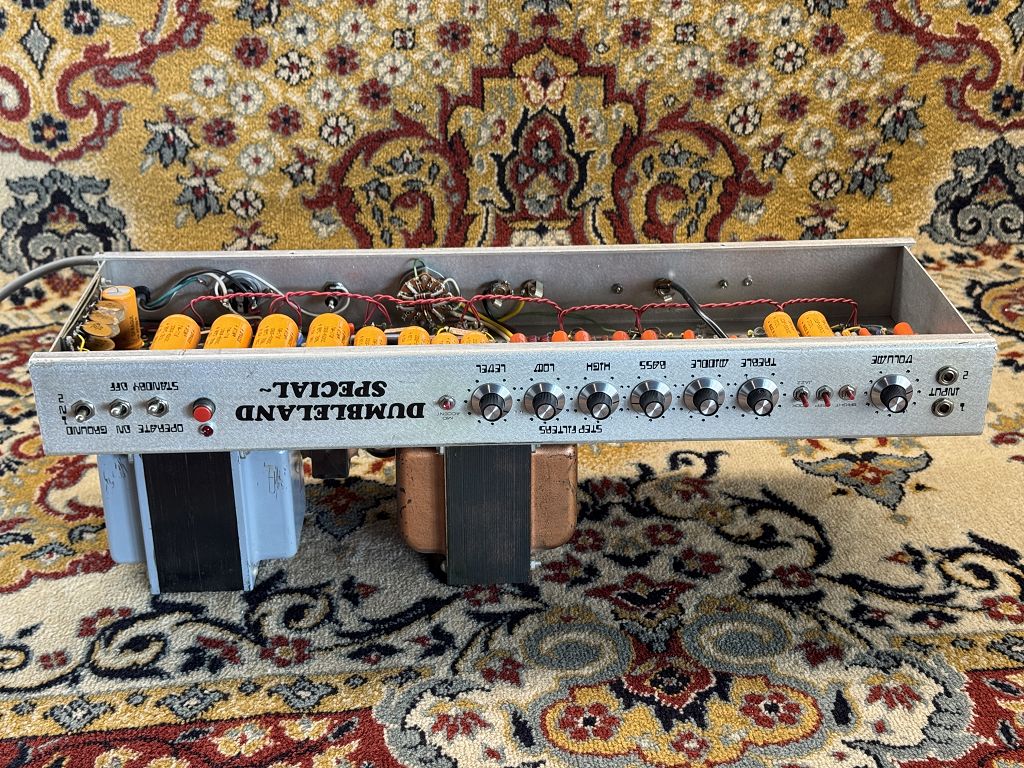
The chassis is a work of art, made of thick aluminum and neatly welded all around to support the weight of the transformers. The remaining components are typical of those manufactured in the United States in the 1970s: Sprague Atom electrolytic capacitors, Sprague Orange Drop coupling capacitors, carbon-compressed and carbon-film resistors, and CTS potentiometers. So that can’t be the reason.
So we connected the device to the XP-D12 (Xtended Port Double 12″) speaker and hooked up the voltage converter—equipped with two Triad transformers—in front of it.

From that point on, everything changed. I’ve never heard an amp with such dynamics or sustain that even comes close to this. Mind you, there’s no overdrive circuit in Dumbleland—the amp is clean as can be. Sure, you can turn up the volume knob and use the level control to reduce the final volume, but the distortion is so subtle that you don’t even notice it at first.


The Dumbleland can’t really be quiet. A certain basic volume level is necessary for the amp to “breathe.” Then it’s loud, but not unbearable. Of course, the 150 watts could replace the PA system in most bands, but the secret isn’t the volume—it’s the power.
In the amp testing room here in the lounge, there are a few U.S. license plates hanging on the wall. Were hanging.. I had to take them off—the rattling was really annoying. The other religious items also needed to be stowed away properly or removed so they wouldn’t fall off the shelves.
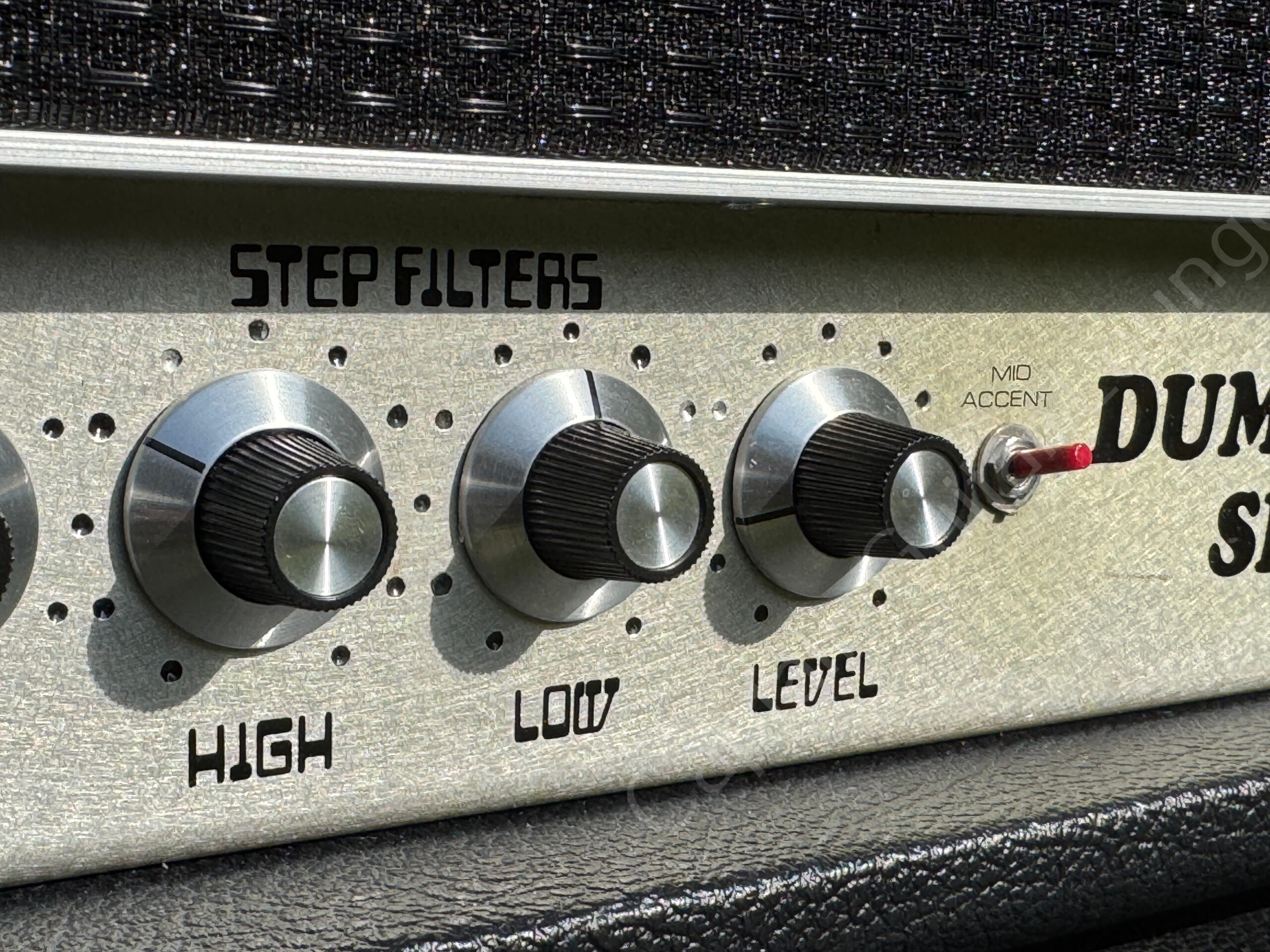
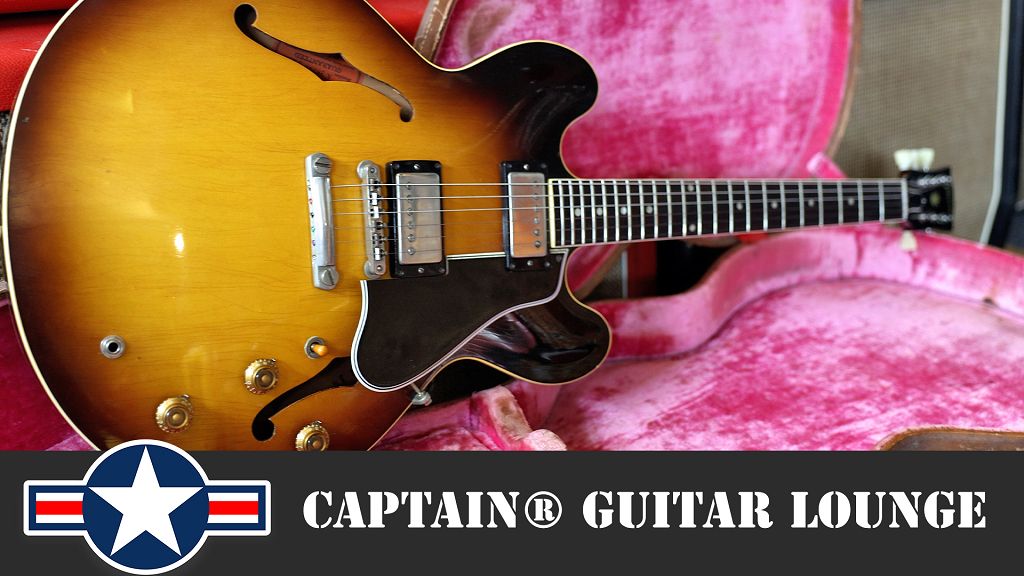
This effect can be adjusted using the “Step Filters Low” rotary switch. If you crank up the bass here, it produces a rumbling like thunder that makes you afraid the ’58 ES-335 will fall apart. These two “High” and “Low” rotary switches are one of the secrets of this amplifier. With just a few clicks up or down, you can quickly and precisely adjust the sound here, whether you’re plugged in with a 335 or a Maple Neck Strat.
The speaker cabinet, shaped like a folded horn and housing the two EVM-12L speakers, handles the excessive power without complaint; the laces flutter merrily in the wind in front of the sound outlet near the floor.
You can get a sense of the sound by watching the YouTube videos:


Most of us have heard a Dumble at some point. While at Jackson Browne’s studio, Stevie Ray Vaughan borrowed, among other things, a “Dumbleland” amp to record a few demos. These demos were released as his album “Texas Flood.” This Dumbleland, numbered #0005, is now owned by John Mayer.

The following is known about the history of #0011, though it is not documented in writing: This Dumbleland Special was imported to Germany in the early 1980s by Applied Acoustics (Brothers Roy, founders of Kitty Hawk), which Howard Dumble had commissioned at the time to handle the distribution and service of Dumble products in Europe, and sold to a bassist from the Ruhr region.
A few years later, he sold the amplifier to another bassist from the Münsterland region through an ad in the trade magazine *Musikmagazin*.
In 2007, the amp went to a collector in Bavaria, where the current owner purchased it in 2017. Anselm provides a deeper look into the technology in his post “Dumbleland Special #011—A Technical Analysis.”
Welcome to Dumbleland
And here, just for fun, is the Dumble price list from 1978. At that time, the dollar was trading at about 2 D-Mark, which was essentially one Euro.
There is no record of how much the amp cost here in Germany at Applied Acoustics.

There was something else. Oh, right, the guitar.
Next to this iconic amp, it almost gets lost in the mix. This Goldtop is also something very special: It is part of what they call EARLY SERIES at www.latesixtieslespauls.com , which were built from August 1968 to May 1969.

It has a one-piece mahogany neck and a center-joined maple top. The neck joint still features the long tenon, just like it was built in the 1950s. The logo is missing the dot on the “i,” and the “b” and “o” are open at the top. So, more like early 1969.

That’s the theory, but take a look at this guitar: I’ve never seen a guitar from that era in better condition. When Maximilian brought it over to us in the lounge, I initially thought it was an instrument from the Gibson Custom Shop’s current lineup. Unfortunately, no aging ☹

Upon closer inspection, it quickly became clear that this was not the case and that we were looking at a one-of-a-kind collector’s item.
The body is made of beautifully figured mahogany—I’ve never seen anything like it. The paint is almost pristine; there are hardly any signs of wear.

The guitar has a great resonance and an endlessly long sustain. One small downside: at 5.1 kg, 3-hour gigs are a bit of a struggle. But I think *The Lady* is more likely to be performed on the sofa than on stage.
This ’69 Goldtop as well as the Dumbleland are now available for purchase at the Captain Guitar Lounge!
And here are the outtakes from the Dumbleland Sessions.